.png?w=651&h=308)
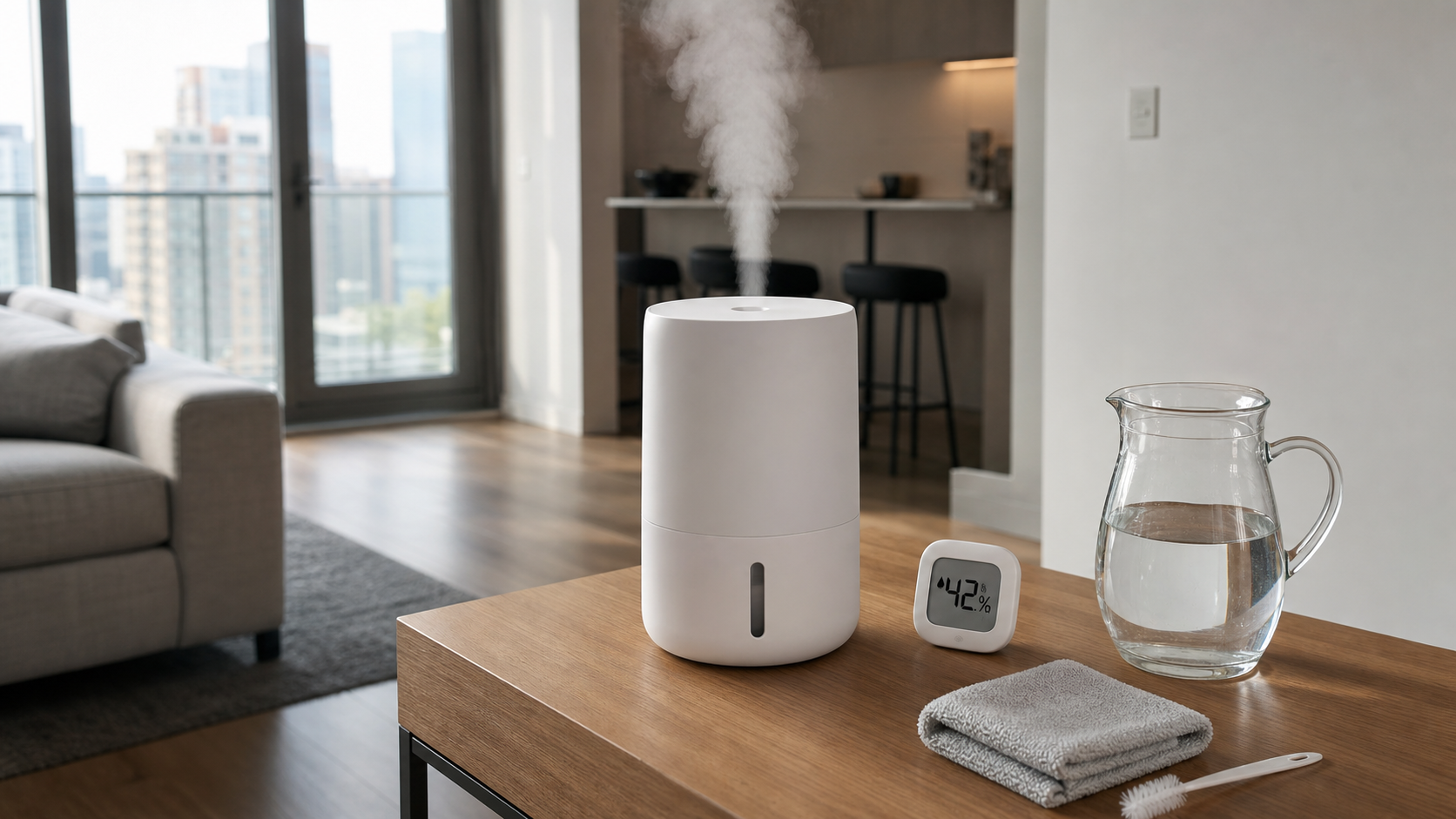
The short answer: choose a portable humidifier by the space you will actually use it in, how often you can refill and clean it, and whether its instructions match your intended use. Place a separate hygrometer in the room and use the humidifier only when more moisture is needed. Health Canada advises measuring indoor humidity and generally keeping it around 50% in summer and 30% in winter to help prevent mould; its broader healthy-home guidance describes a 30% to 50% range. Empty leftover water after use, clean and disinfect the reservoir on the manufacturer’s schedule, and add essential oils only when that exact model expressly permits them.
This is a selection and maintenance guide, not medical advice. A portable humidifier adds moisture; it is not an air purifier, sterilizer or treatment for illness. Humiii currently lists compact options including the Double Spray Wireless Humidifier, Wireless Ultrasonic Air Mist, Cactus Wireless Humidifier, and Portable Air Mist Humidifier. Check the live product page for current capacity, charging, runtime, mist modes and care instructions before ordering.
Portable humidifier choices at a glance
| Question | What to check | Why it matters |
|---|---|---|
| Where will it run? | Room size, stable surface and nearby moisture-sensitive objects | A compact personal unit and a larger-capacity unit serve different spaces |
| How often can you refill? | Reservoir capacity and stated runtime at each mist setting | Runtime varies with output mode; capacity alone does not settle it |
| How will you power it? | USB, rechargeable battery, cord requirements and included accessories | “Wireless” does not mean the unit never needs charging |
| Can it be cleaned easily? | Reservoir opening, removable parts, filter or wick availability | A practical cleaning routine is more useful than a feature you will not maintain |
| Do you want fragrance? | Explicit manufacturer approval for oils and the named oil compartment | Oil can damage a water tank, wick or ultrasonic mechanism not designed for it |
| Is more humidity needed? | A separate hygrometer and signs of condensation | Running by feel can push humidity above the useful range |
1. Start with a hygrometer, not the mist setting
A hygrometer measures relative humidity. Place it in the occupied area, away from the direct mist stream, radiator, sunny window or steamy kitchen. Take a reading before turning the humidifier on and check it again after the room has had time to respond. Health Canada recommends controlling moisture and generally maintaining relative humidity between 30% and 50%; its cool-mist guidance gives the seasonal reference points of about 50% in summer and 30% in winter. The building, weather and condensation risk still matter.
If windows, walls or nearby surfaces become damp, lower the output or stop the unit and address the excess moisture. A humidifier should not compete with a damp basement, plumbing leak or existing mould problem. The U.S. Environmental Protection Agency also recommends keeping indoor humidity between 30% and 50% and using a moisture or humidity gauge rather than guessing.
2. Match capacity and output to your routine
Reservoir volume is only one comparison point. Ask how long the unit is stated to run on low and high output, whether it offers intermittent mist, and how easy it is to refill without spilling. The Double Spray Wireless Humidifier may suit shoppers comparing a larger tank and more than one mist outlet; verify its current specifications and charge requirements. The smaller Wireless Ultrasonic Air Mist illustrates the trade-off at the compact end: portability can mean a smaller reservoir and more frequent attention.
Do not infer whole-room coverage from a dramatic product photo or visible plume. SHOPLINE listings can change, so use the live specifications. A model that fits a desk or travel bag may be convenient for personal use, but convenience does not remove the need to empty and clean the reservoir.
3. Choose a safe, dry placement
- Use a level, stable, water-resistant surface where the unit cannot be knocked over.
- Keep mist away from walls, windows, books, electronics, wood finishes, bedding and other moisture-sensitive items.
- Leave the air inlet and mist outlet unobstructed, using the clearance in the model instructions.
- Keep cords, charging equipment and adapters dry, and use only the specified power source.
- Keep the unit and its water out of reach of children and pets; decorative lighting does not make it a toy.
- Do not place it where condensation forms or where spilled water could create a slip or electrical hazard.
Health Canada’s cool-mist guidance recommends a central location and keeping the unit out of the bedroom, especially overnight. Follow the manufacturer’s placement instructions when they are more specific. For a decorative model such as the Cactus Wireless Humidifier, treat the shape and light as design features, not evidence that it belongs beside a child’s pillow or unattended on a narrow shelf.
4. Use water the model permits
Health Canada says tap water is acceptable in most cases when the water is changed and the humidifier is cleaned regularly. It also explains that the dust-like mineral particles sometimes seen near cool-mist units are generally much lower when distilled water is used. If your tap water creates visible white dust or scale, distilled or demineralized water may reduce mineral residue—provided the manufacturer allows it.
Never substitute fragrance, cleaner, disinfectant or another liquid for water unless the instructions explicitly direct it. Do not drink or reuse reservoir water. Refill with fresh water only when you are ready to operate the unit.
5. Build cleaning into every use
- Turn off and disconnect the unit. Follow the manual for rechargeable models before opening or moving wet parts.
- Empty leftover water. Health Canada specifically advises never leaving water sitting in a cool-mist humidifier between uses.
- Rinse or wipe only as directed. Protect the motor, charging port and electronics from immersion.
- Clean and disinfect on the manufacturer’s schedule. Use the named product, dilution and contact time; do not combine cleaning chemicals.
- Address scale separately. Follow the manual’s descaling directions rather than scraping the ultrasonic plate or improvising an acid concentration.
- Rinse and dry completely. Reassemble only after the approved parts are clean and dry.
- Replace filters or wicks as specified. Confirm replacement availability before choosing a model that uses them.
A quick top-up is not a cleaning cycle. Stagnant water can support microbial growth, and a cool-mist device does not boil the water before dispersing it. If a reservoir smells unusual, contains film or has been stored wet, stop using the unit and follow the manufacturer’s full cleaning directions before restarting it.
6. Treat essential-oil compatibility as model-specific
Product names and marketplace descriptions sometimes use “humidifier,” “air mist,” “aroma diffuser” and “essential-oil diffuser” together. They are not automatically interchangeable. Only add oil when the current instructions for the exact model expressly permit it, and only in the location and amount stated. If the manual does not authorize oil, use plain permitted water.
Even when a listing describes aroma use, confirm whether oil goes into the reservoir, a separate tray or an absorbent pad. Oil can degrade plastics, clog a wick, coat an ultrasonic element or void instructions when used in the wrong place. The Portable Air Mist Humidifier should therefore be checked against its current instructions rather than the category name alone. Avoid therapeutic, antibacterial or air-cleaning assumptions.
A practical pre-purchase checklist
- Record the intended room and measure its current humidity.
- Compare capacity, stated runtime and output modes on the live page.
- Confirm power, charging time, cable and adapter requirements.
- Check whether the reservoir and mist outlet are easy to access for cleaning.
- Identify every consumable filter or wick and where replacements come from.
- Read the water, descaling and disinfecting instructions before buying.
- Verify oil compatibility in the exact model manual, not a category label.
- Review current shipping, warranty and return terms.
Frequently asked questions
What indoor humidity should I aim for?
Use a hygrometer. Health Canada’s healthy-home guidance recommends 30% to 50% relative humidity, while its cool-mist guidance uses about 50% in summer and 30% in winter to help prevent mould. Reduce output if condensation appears.
Should I use distilled water?
Follow the model instructions. Health Canada says tap water is fine in most cases with regular water changes and cleaning, but distilled water generally produces fewer mineral particles in cool-mist use. Distilled water does not replace cleaning.
Can I run a portable humidifier all night?
Do not assume so. Follow the manufacturer’s supervision and runtime instructions, monitor humidity, and note that Health Canada recommends keeping cool-mist humidifiers out of the bedroom, especially at night.
Can a humidifier purify the air?
No. A humidifier’s purpose is to add moisture. It should not be presented as an air purifier, sterilizer, bacteria-killing device or substitute for ventilation and source control.
Can every humidifier use essential oils?
No. Use oil only when the exact model’s manufacturer instructions explicitly allow it, in the stated compartment and amount. Otherwise use plain permitted water.
How often should I clean it?
Empty leftover water after use and follow the manufacturer’s cleaning and disinfecting schedule. Frequency depends on design and use; do not invent a universal chemical recipe.
Bottom line
The best portable humidifier is not simply the one with the largest tank or strongest visible mist. It is the model whose capacity, power and controls suit your space—and whose reservoir you can realistically empty, clean and dry. Pair it with a separate hygrometer, keep indoor humidity in a sensible range, place it away from moisture-sensitive items, and treat water and essential-oil instructions as model-specific.